Four Type Materials of Facuet Guide for OEM Buyer
2026-10-15
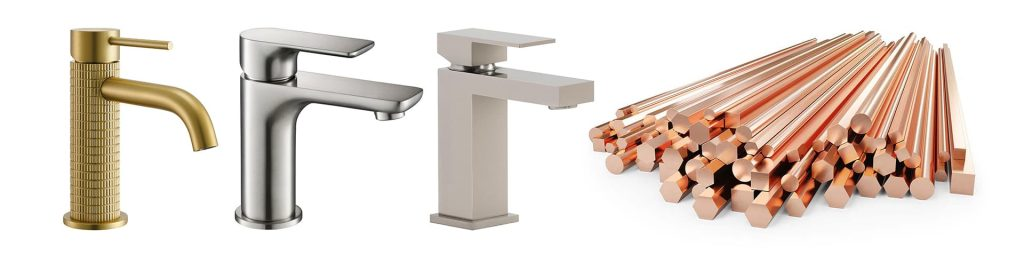
A buyer inquire a chrome faucet to numerous Chinese manufacturers. He received hundreds of quotations, with prices ranging from $3 to $30 . Why the price gap of a chrome faucet is so different? The size and the finish of their samples seems very similar. While some perform flawlessly in various environments— let buyer earn brand reputation and trust from customers—others may crack or leak after only a brief period of use, leaving buyer's after-sales team with a constant stream of headaches. As the old saying goes, "you get what you pay for." The secret is the material composition of the faucet. That's why an experienced buyer will ask more deeper question to factory, like " what is the material of each components of the products, what is its production process, and does it meet the requirements and certification of my target market?"
As a professional manufacturer with 20 years experience, let us give your a comprehensive analysis of different material of faucet —plastic, zinc alloy, brass, and stainless steel.
I. Plastic Faucets: An Affordable "Temporary" Solution
Plastic faucets represent a significant product category within the global plumbing market. While brass and stainless steel remain the dominant choices for mid-to-high-end residential installations, plastic faucets—thanks to their distinct advantages—continue to be the preferred option in specific settings and regions. These advantages include being lead-free, completely corrosion-resistant, highly cost-effective, and lightweight. Consequently, they remain a mainstream choice for applications such as agricultural irrigation, industrial environments involving acids or alkalis, outdoor sinks, temporary housing (including rental properties), and markets across developing regions like Southeast Asia and the Middle East. Plastic faucets are typically made from engineering plastics (such as ABS or PPR). Due to their low manufacturing costs, they are the most budget-friendly option available.
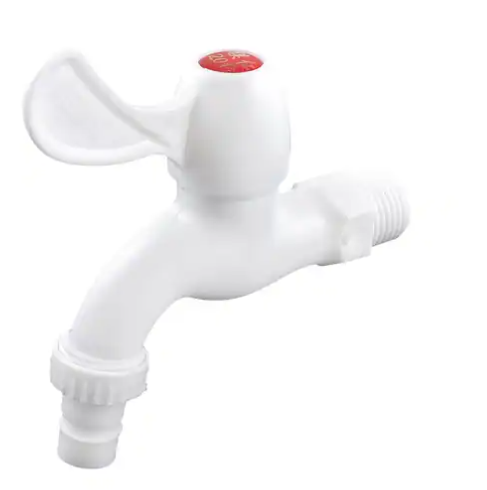
1.Advantages of Plastic Faucets
- Completely lead-free with zero heavy-metal leaching: Unlike conventional low-end brass faucets, which pose a risk of lead leaching, plastic materials contain no heavy metals, ensuring a purer and healthier water supply.
- Exceptional corrosion resistance—no rust or limescale buildup: Plastic is naturally resistant to acids, alkalis, salts, and residual chlorine in water. In environments such as coastal areas (exposed to salt spray), industrial settings with acidic or alkaline substances, or regions with hard water, plastic faucets often outperform their metal counterparts in terms of longevity.
- Low cost and high cost-effectiveness: Compared to the complex machining and polishing required for brass or stainless steel, plastic faucets are manufactured via injection molding—a process that offers extremely high production efficiency and a very low per-unit cost.
- Low thermal conductivity—prevents scalding: When exposed to high-pressure hot water, the plastic housing does not become dangerously hot to the touch like a metal faucet, offering a more comfortable, moderate surface temperature.
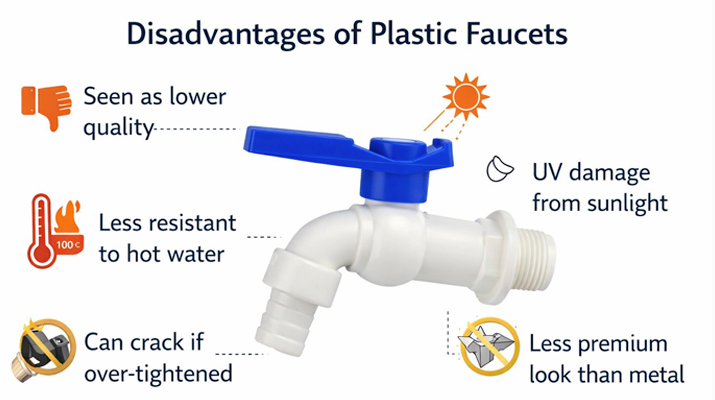
2. Disadvantages of Plastic Faucets
- Low resistance to pressure and impact: These materials are prone to brittle fracture or pipe bursts when subjected to severe water hammer effects or freezing temperatures during winter.
- Poor resistance to aging (UV exposure): Standard plastics tend to turn yellow, become brittle, and fade when exposed to sunlight (ultraviolet radiation) for extended periods.
- Limited structural quality and mechanical durability: Threaded connections are less robust than those made of metal and are prone to stripping (slipping) with repeated tightening; furthermore, they lack the substantial, solid feel of metal components.
3. Industry Nuances and Manufacturing "Unwritten Rules":
While plastic faucets may appear simple, there is a significant depth to the variations in quality and the technical intricacies involved:
Nuance 1: "Electroplated ABS" masquerading as metal.
Many consumers purchase faucets with a brilliant, mirror-like chrome finish, assuming they are made of solid brass or stainless steel—only to discover, once the surface wears down, that the interior is actually plastic. The technical process: Through specialized chemical plating (copper/nickel/chrome), ABS plastic can achieve a luster that rivals metal faucets. In the industry, high-end bathroom brands (such as Hansgrohe or Grohe) frequently use ABS or POM for components like handheld showerheads, overhead showers, and pull-out faucet spray heads—primarily to reduce weight (preventing injury if dropped) and to provide heat insulation (preventing burns). Conversely, low-end manufacturers use these materials to deceptively pass off plastic products as solid brass, charging premium prices.
Nuance 2: "POM Cartridges" vs. "Standard Cartridges."
The lifespan of a plastic faucet is determined not by its outer shell, but by its internal cartridge and threading. Inferior plastic faucets often rely on basic PP (polypropylene) or PVC for internal components; within a few months, the threads may wear down or the seals may fail, leading to leaks. High-quality plastic faucets, by contrast, utilize a core cartridge made of POM (acetal)—often paired with ceramic discs—which offers an extremely low coefficient of friction and exceptional wear resistance, allowing for hundreds of thousands of operational cycles.
Nuance 3: Virgin Resin vs. Recycled Plastic.
Virgin engineering resin (new material) is characterized by pure color, high toughness, an absence of odor, and excellent pressure resistance. In contrast, many low-cost manufacturers use recycled plastic pellets. This results in impurities within the faucet, a drastic reduction in pressure tolerance, and the potential release of volatile organic compounds (VOCs) or unpleasant odors when exposed to heat.
Nuance 4: Embedded Metal Threads (Brass/Stainless Steel Inserts).
Since tapping threads directly into plastic can easily lead to stripped threads or cracking when connected to metal water pipes, mid-to-high-end plastic faucets feature brass or stainless steel threaded inserts—integrated via overmolding—at the water inlet and connection points. This "metal-insert, plastic-body" design retains the advantages of plastic—namely, corrosion resistance and a lead-free composition—while resolving the critical issue of insecure installation connections.
II. What Is Zinc Alloy?
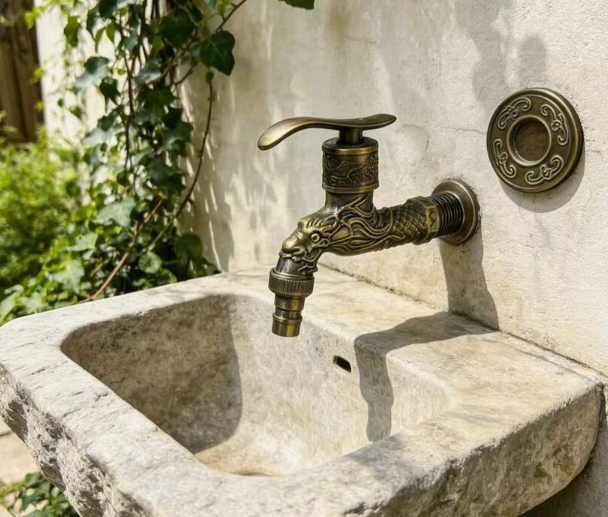
In the faucet market, zinc alloy (Zamak) is arguably the most controversial material. It is notorious as a primary source of low-quality, high-markup products—often used deceptively as a substitute for brass—yet, when processed via modern die-casting techniques, it also serves as a cost-effective material capable of achieving sophisticated, artistic designs. The zinc alloys used for manufacturing faucets—most notably Zamak-3 and Zamak-5—consist primarily of zinc (over 90%), combined with small amounts of elements such as aluminum, copper, and magnesium. Unlike brass or stainless steel, zinc alloy has a relatively low melting point (approximately 380°C–390°C) and excellent fluidity, making it exceptionally well-suited for efficient die-casting processes.
1. Key Advantages of Zinc Alloy Faucets
- Cost-Effective for Complex, Aesthetic Designs: Zinc alloy exhibits excellent fluidity when molten, allowing for the easy die-casting of intricate shapes—ranging from European-style vintage carvings and minimalist streamlined forms to complex geometric, multi-faceted structures. Achieving such complexity with brass or stainless steel would lead to a dramatic surge in costs due to intensive CNC machining and increased mold wear.
- Highly Receptive to Surface Finishes: Once polished, the zinc alloy substrate becomes exceptionally smooth, making it an ideal base for a wide variety of sophisticated surface treatments—such as chrome plating, matte black finishes, gunmetal grey, or gold plating. Fresh from the factory, these faucets can offer a visual quality and luxurious feel that even surpasses many low-end brass alternatives.
- Low Raw Material and Production Costs: The cost of zinc as a raw material is significantly lower than that of copper (brass is typically more than two to three times the price of zinc alloy). Furthermore, the high speed of the die-casting process and a high yield rate contribute to a substantial reduction in overall manufacturing costs.
2. Fatal Flaw: Why Zinc Alloy Is Not Recommended for Primary Water-Bearing Components
Although these items may look stunning when brand new, zinc alloy suffers from inherent structural weaknesses:
- White Rust and Intergranular Corrosion: While zinc does not develop red rust like iron, it is highly susceptible to electrochemical corrosion in warm, humid, chloride-rich, or constantly wet environments—manifesting as a white, powdery substance (zinc oxide/zinc hydroxide). Over time, the internal metallic structure becomes porous (spongy) and brittle.
- Poor Resistance to Water Pressure and Mechanical Stress: Zinc alloy lacks the toughness and tensile strength of brass or stainless steel. It is prone to developing micro-cracks—or even suffering catastrophic, instantaneous rupture—when subjected to high-pressure water hammer (such as that caused by suddenly closing a valve) or the expansion that occurs if water freezes inside during winter.
- Irreparable Once Fractured: If a zinc alloy component cracks and begins to leak, it cannot be repaired through welding; the entire part must be discarded and replaced. Its typical service life is only 1 to 3 years.
3. Industry Know-How and the Truth About "Copper Substitutes"
Insight 1: How do reputable brands properly use zinc alloys?
High-end, established bathroom fixture brands do not avoid zinc alloys entirely; rather, they use them in the "right places":
Main body (parts that carry water and withstand pressure): Strictly made from solid copper (H59 or lead-free copper) or 304 stainless steel.
Handles/Controls (parts that do not carry water or withstand pressure): Frequently made via zinc alloy die-casting. Since handles are not subject to water pressure and allow for diverse, intricate designs, using zinc alloy die-casting helps lower the overall cost of the faucet while ensuring the safety and integrity of the water-carrying main body.
Insight 2: The "bait-and-switch" tactics of low-end "fake solid copper" faucets
In some low-end wholesale markets or obscure online shops, there is a prevalent practice of manufacturing the main body of a faucet entirely out of zinc alloy while misrepresenting it as solid copper:
Electroplating as a disguise: Once a zinc alloy component is chrome-plated, it is impossible to discern the underlying metal with the naked eye.
Adding weight: Zinc alloy has a density (approx. 6.6 g/cm³) that is about 20%–30% lower than that of copper (approx. 8.5 g/cm³). To deceive buyers, unscrupulous sellers may insert iron blocks or thick plastic liners into the internal water chambers of zinc alloy faucets, making them feel heavy—a characteristic buyers often associate with solid copper.
Consequences of use: After one to two years of use, the internal water channels of these all-zinc-alloy faucets can become completely pulverized due to limescale buildup and corrosion. This can lead to pipe bursts, water leaks that flood your floors, or even the faucet snapping off inside the wall-mounted plumbing—making it extremely difficult to extract.
III. Copper Alloys (Brass): The Enduring "Industry Leader"
In the faucet industry, "all-copper" faucets have long been synonymous with high-end quality, durability, and superior craftsmanship. In reality, however, the term "all-copper" does not mean 100% pure copper—which is too soft for precise casting or machining—but rather refers to faucets manufactured using brass (an alloy of copper and zinc) as the base material.
Different countries and specific applications impose rigorous requirements on the composition of brass, particularly regarding the proportions of copper, zinc, lead, and elements designed to prevent dezincification. This guide provides an in-depth look at the secrets behind the manufacturing of brass faucets, exploring the differences between common industry-standard alloys—such as H59 brass, DZR (dezincification-resistant) brass (e.g., CW602N), and lead-free brass—along with other essential industry insights.
Different countries and specific applications impose rigorous requirements on the composition of brass, particularly regarding the proportions of copper, zinc, lead, and elements designed to prevent dezincification. This guide provides an in-depth look at the secrets behind the manufacturing of brass faucets, exploring the differences between common industry-standard alloys—such as H59 brass, DZR (dezincification-resistant) brass (e.g., CW602N), and lead-free brass—along with other essential industry insights.
1. Why is "brass" the preferred material for faucets?
Among various metallic materials, brass has dominated the plumbing and bathroom fixture industry for over a century, primarily due to three inherent advantages:
- Natural Antimicrobial Properties (Oligodynamic Effect): Copper ions possess potent antimicrobial and bactericidal capabilities, capable of eliminating or inhibiting the growth of over 99% of bacteria within the water system in under 24 hours.
- Excellent Castability and Machinability: With a moderate melting point and high fluidity, brass is ideally suited for gravity casting or precision CNC machining, allowing for the creation of highly accurate valve cavities and complex, curved pipe geometries.
- Wear Resistance and Ease of Electroplating: Brass offers high mechanical strength, and its surface readily accepts electroplated coatings—such as nickel, chrome, or PVD finishes—resulting in a mirror-like luster and exceptional corrosion resistance.
2. In-depth Guide to Common Brass Alloys for Faucets
There is a wide variety of brass alloys used for faucets on the market. The specific alloy grade directly determines a product’s environmental safety rating, corrosion resistance, lifespan, and production cost.
Standard Brass: H59 / H62 Brass(CW617N / C37700)
Composition: H59 indicates a copper content of approximately 59% (with the remainder consisting primarily of zinc, along with about 1.0%–3.0% lead). This is the most widely used standard brass in the global plumbing industry.
Composition: H59 indicates a copper content of approximately 59% (with the remainder consisting primarily of zinc, along with about 1.0%–3.0% lead). This is the most widely used standard brass in the global plumbing industry.
Why is lead added? Lead acts as a "lubricant" within the brass, significantly reducing cutting resistance. This allows automated CNC machine tools to process valve threads and internal water channels with high efficiency, while also minimizing wear on cutting tools.
Applications and Assessment: These alloys offer an excellent balance of cost and performance, with stable strength and mechanical properties. They are commonly used for the main bodies of standard hot/cold basin faucets and kitchen faucets. However, if the material has not undergone a "de-leading" (lead-removal) process, prolonged exposure to stagnant water may cause trace amounts of lead to leach into the water, potentially exceeding safety limits.
Dezincification-Resistant (DZR) Brass
Representative Grades: CW602N / CZ132 / C35330
Representative Grades: CW602N / CZ132 / C35330
Core Characteristics: In standard brass, exposure to acidic water, high chloride ion concentrations, or hard water can cause the zinc component to corrode and leach out—a process known as "dezincification." Once dezincified, the internal structure of the faucet becomes porous, resembling a sponge; this weakens the material, causes it to turn whitish, and can lead to leaks or structural failure.
How DZR Works: DZR brass is engineered by strictly controlling the copper-to-zinc ratio and incorporating trace amounts of elements such as arsenic (As) or antimony (Sb). These additions stabilize the alloy's phase structure, making it highly resistant to dezincification. Applicable Regions and Standards: In regions such as Australia (WaterMark certification), the United Kingdom (WRAS certification), and New Zealand—where water quality conditions are unique—the use of DZR (dezincification-resistant) brass is mandatory for all metal components that come into contact with water.
Lead-Free / Low-Lead Brass
Representative Grades: C27453, C27450, Eco Brass (C69300), and Silicon Brass.
Representative Grades: C27453, C27450, Eco Brass (C69300), and Silicon Brass.
Core Definition: In a strict sense, "lead-free" brass does not mean it contains absolutely zero lead. Rather, it refers to alloys with a lead content of less than 0.25%—meeting standards such as the U.S. NSF/ANSI 61 and California’s AB 1953—or complying with even more stringent regulations regarding the leaching of heavy metals into drinking water, as seen in California and across Europe.
Manufacturing Challenges: Without the lubricating effect of lead, the machinability of brass becomes exponentially more difficult. This leads to rapid tool wear and higher scrap rates during casting. To compensate for the absence of lead, elements such as bismuth (Bi), silicon (Si), or selenium (Se) are typically added.
Applications and Assessment: This material is the standard choice for high-end markets in Europe and the United States, as well as for top-tier plumbing and sanitary ware brands. It serves as the definitive solution to the issue of lead contamination in drinking water from faucets, though it carries a cost 30% to 50% (or more) higher than that of conventional H59 brass.
3. Industry Insights and Insider Secrets of Brass Faucets
Insight 1: Sand Casting vs. Gravity Casting vs. Forging
Even when using the same grade of brass, the casting process used leads to vast differences in quality:
- Sand Casting (Low-end): Uses sand molds. This method often results in internal air pockets, sand inclusions, and impurities. Over time, these microscopic pores can lead to water seepage, and the internal surfaces are typically extremely rough.
- Gravity Casting (Mainstream/High-quality): Molten brass is poured into precision steel molds using gravity. This produces a high-density, non-porous structure with exceptional resistance to pressure and bursting.
- Hot Forging (High-end): Brass rods are heated and then shaped using high-pressure stamping. This creates an extremely dense material that completely eliminates the risk of leakage.
Insight 2: The "Lead-Washing" Process
Because lead-free brass is prohibitively expensive, many high-quality manufacturers use a process involving "H59 (standard) brass gravity casting" combined with "chemical lead-washing" of the internal water channels. By soaking the water-contact passages in a strong acid, lead elements within the surface layer (a few microns deep) are leached out. This ensures the product meets international standards for lead leaching in drinking water without the massive cost of using lead-free raw materials.
Insight 3: Assessing Brass Quality via Surface Plating (Chrome/PVD)
For high-quality brass faucets, the surface plating is not intended to hide defects, but rather to protect the brass body.
Top-tier Standard: Must pass a 24-hour Acid Salt Spray (ASS) test at a Grade 10 rating (or over 200 hours in a Neutral Salt Spray/NSS test).
Layered Structure: High-quality brass faucets typically feature at least three layers of plating: a copper base coat, a nickel layer (for corrosion resistance), and a final chrome or PVD-colored layer (for high hardness and wear resistance). If the underlying brass contains too many impurities, the plating will begin to blister and peel within six months.
IV. Stainless Steel Faucets: A Healthy and Eco-Friendly "Rising Star"
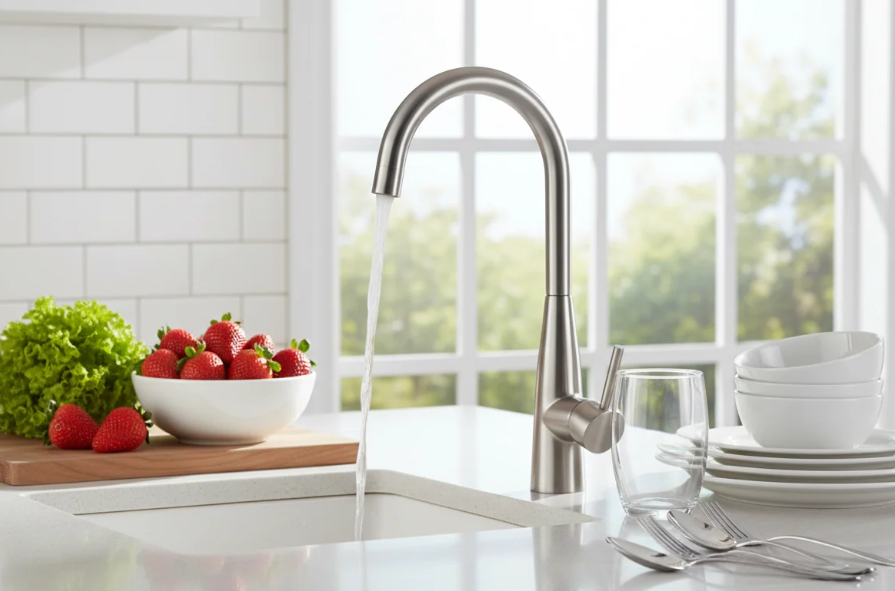
In the evolution of faucets, stainless steel faucets have emerged as a prominent newcomer in recent years. Thanks to their inherent lead-free, eco-friendly nature, exceptional corrosion resistance, and the elimination of wastewater pollution associated with electroplating, they are rapidly capturing market share from traditional brass faucets in both kitchen and high-end bathroom segments.
1. Core Material: 304 vs. 201 (The Key Factor Determining Lifespan)
At its core, stainless steel is an iron alloy containing elements such as chromium (Cr) and nickel (Ni). Its surface relies on an extremely thin yet robust "dense chromium oxide passive film" that prevents oxygen atoms from penetrating, thereby ensuring the metal remains rust-free.
However, in the market for bathroom fixtures and building materials, choosing the wrong grade of stainless steel is essentially a waste of money:
| Stainless Steel Grade | Core Composition | Corrosion and Rust Resistance | Industry Applications & Use Cases |
|
SUS 304
(Food Grade)
|
18% Chromium + 8% Nickel | Excellent. Resistant to acids, alkalis, and salt spray; remains rust-free for decades, even in humid environments. | The standard material for high-quality stainless steel faucets; food-contact safe and hygienic. |
|
SUS 316
(Medical Grade)
|
Contains Molybdenum (Mo) | Superior. Exceptional resistance to chloride corrosion; suitable for marine (seawater) environments. | Used by top-tier premium brands or for specialized medical and coastal applications; extremely high cost. |
|
SUS 201
(Industrial Grade)
|
Uses Manganese (Mn) to replace Nickel; low Nickel content | Very Poor. Develops rust spots within months when exposed to humid bathroom conditions or saline water. | Found in low-end, inferior-quality faucets; often electroplated to mimic 304-grade stainless steel. |
2. Key Advantages of Stainless Steel Faucets
- Completely Lead-Free: Ensuring Drinking Water Safety at the Source
Stainless steel contains no lead, and there is zero heavy-metal leaching when water passes through it. This makes it the most effective physical solution for eliminating lead contamination in household drinking water (an especially important benefit for kitchen tasks like washing produce or dishes).
- No Electroplating Required: Durable and Eco-Friendly
Traditional brass faucets rely on electroplating to prevent rust; however, once the plating wears off, the surface can easily rust or blister. In contrast, 304 stainless steel faucets—finished via brushing, polishing, or PVD coating—are ready for use as-is. Their surfaces are highly resistant to wear and scratches; even after decades of use, a quick scrub with a scouring pad can restore them to a like-new appearance.
- Exceptional Resistance to Acids, Alkalis, and Corrosion
When exposed to hard water, strong acidic or alkaline cleaning agents, or dish detergents, 304 stainless steel does not suffer from the oxidation, blackening, or "dezincification" (zinc leaching) common in brass.
Robust Structure: Pressure-Resistant and Explosion-Proof
Stainless steel possesses far greater hardness and toughness than brass or zinc alloys. It can withstand higher water pressure and the impact of "water hammer" effects, making it highly resistant to cracking or bursting—even in freezing conditions.
Stainless steel possesses far greater hardness and toughness than brass or zinc alloys. It can withstand higher water pressure and the impact of "water hammer" effects, making it highly resistant to cracking or bursting—even in freezing conditions.
3. Disadvantages and Manufacturing Challenges (Why Are Prices So High?)
If stainless steel is so superior, why hasn't it completely replaced brass?
Extreme Manufacturing Difficulty and High Material Waste
Stainless steel is hard, "sticky" (gummy), and has poor thermal conductivity, which causes rapid wear on cutting tools during CNC machining and drilling. Producing a single valve body in stainless steel incurs significantly higher costs for tool wear and requires much more processing time compared to brass.
Stainless steel is hard, "sticky" (gummy), and has poor thermal conductivity, which causes rapid wear on cutting tools during CNC machining and drilling. Producing a single valve body in stainless steel incurs significantly higher costs for tool wear and requires much more processing time compared to brass.
Limited Design Versatility
Due to its high hardness and high melting point (over 1400°C), stainless steel cannot be easily die-cast into the complex, ornate European-style carvings or intricate, highly curved shapes possible with brass or zinc alloys. Consequently, stainless steel designs tend to lean toward a modern, minimalist aesthetic with clean, sharp lines. High Cost of Precision Casting:
High-quality stainless steel faucet bodies require an expensive precision casting process (silica sol lost-wax casting). Both the production costs and the scrap rates are higher than those associated with the traditional gravity casting method used for brass.
4. Industry Ins and Outs: A Guide to Avoiding Pitfalls
Pitfall 1: The "Fake 304" Trap (Substituting with 201 Stainless Steel)
The most common trap when buying stainless steel faucets is the substitution of inferior materials. Sellers may stamp "304" on a product, while actually using 201 industrial-grade stainless steel.
How to identify: Due to its high manganese content, 201 stainless steel has a duller, darker appearance and is slightly magnetic. In contrast, 304 stainless steel features a soft, lustrous, silver-brushed finish. The most reliable method is to use a "stainless steel testing solution"—apply a single drop; if it turns red within seconds, it is 201, whereas 304 will remain unchanged.
Pitfall 2: Wall Thickness and Manufacturing Methods (Gravity Casting vs. Welded/Stamped Tubing)
Precision-cast, thick-walled (High Quality): Manufactured via silica sol precision casting, these faucets feature uniform wall thickness (typically 2.5mm–3.5mm or greater). They are solid, substantial, and highly resistant to pressure.
Stamped, thin-walled, and welded (Low Quality/Cheap): Made by stamping and bending thin stainless steel tubing, then welding the pieces together. Over time, the internal weld seams are prone to cracking under water pressure and corrosion from limescale, and these joints can also become breeding grounds for bacteria.
Pitfall 3: Surface Finishing (Authentic Mechanical Brushing vs. Faux "Brushed" Paint)
Authentic mechanical brushing: The stainless steel surface is polished using abrasive wheels or belts to create a fine, uniform brushed texture. This finish is natural and will never fade or peel off.
Inferior paint/faux brushing: A gray, "brushed-look" paint is applied to the surface of a low-quality metal. After a few months of use, this paint layer can be corroded by dish soap or acidic cleaning agents, leading to significant flaking or peeling.
Conclusion
With an understanding of these four mainstream materials, the selection process becomes quite clear: for buyers who prioritize quality and durability, high-grade brass and 304 stainless steel stand out as the two best choices for an optimal overall experience.
As a professional brand specializing in mid-to-high-end bathroom fixtures, Rainparty focuses exclusively on the R&D and precision manufacturing of brass and 304 stainless steel faucets:
International Compliance: From the careful selection of raw materials to the final finished product, Rainparty adheres to rigorous quality control standards. Our products fully comply with the import, water-efficiency, and environmental regulations of major global markets, including Australia (WaterMark certification), Europe, and the Middle East (such as SASO standards).
International Compliance: From the careful selection of raw materials to the final finished product, Rainparty adheres to rigorous quality control standards. Our products fully comply with the import, water-efficiency, and environmental regulations of major global markets, including Australia (WaterMark certification), Europe, and the Middle East (such as SASO standards).
Extensive Manufacturing Expertise: Rainparty combines custom ODM/OEM R&D and design capabilities with large-scale production capacity. We provide commercial clients and end-users worldwide with high-quality, low-lead, eco-friendly, and stylish faucets and shower systems designed for long-lasting performance.
A Comprehensive Guide of WaterMark Certification, WELS Water Efficiency Rating, and New Lead-Free Regulations
Global Variations in Water Pressure and Their Impact on Shower Product Selection