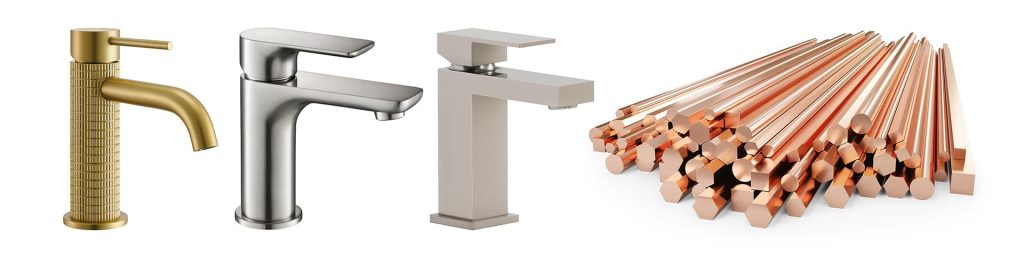
A Comprehensive Analysis of the Bathroom Faucet Manufacturing Process
2023-03-20

For a bathroom faucet, the design and material is the first phase. How to make the draft design be a actual product, and how to make the good quality raw material be fully used? The manufacturing process is the key phase, every step directly affects the product's sealing performance, corrosion resistance, lifespan, and appearance.
This article will explain the complete manufacturing process of bathroom faucets.
This article will explain the complete manufacturing process of bathroom faucets.
I. Raw Material Selection and Control
Common materials for faucets include:
- Brass
- Stainless Steel (e.g., 304/316)
- Zinc Alloy (used for some structural components)
Key Control Points:
Material composition stability (e.g., lead content control)
Meeting drinking water contact safety requirements
Good machinability and corrosion resistance
Material composition stability (e.g., lead content control)
Meeting drinking water contact safety requirements
Good machinability and corrosion resistance
II. Molding Process
Depending on the material, faucet bodies are typically formed using two main methods:
1. Brass Faucets - Casting Process
Process Flow:
Copper smelting
Gravity casting or low-pressure casting
Cooling and demolding
Features:
Capable of complex structures
Good cost control
Most widely used
Capable of complex structures
Good cost control
Most widely used
Key Control Points:
Preventing porosity and sand holes
Improving internal density
Controlling dimensional accuracy
Preventing porosity and sand holes
Improving internal density
Controlling dimensional accuracy
2. Stainless Steel Faucets - Welding Process
Stainless steel faucets are typically formed by welding together processed pipes or sheets.
Process Flow:
Laser cutting or stamping blanking
Bending or forming
TIG welding or laser welding
Weld grinding treatment
Features:
High structural strength
Modern appearance
High requirements for welding process
High structural strength
Modern appearance
High requirements for welding process
Key Control Points:
Weld strength and sealing performance
Smoothness of the welding area
Avoid defects such as porosity and incomplete welds
Weld strength and sealing performance
Smoothness of the welding area
Avoid defects such as porosity and incomplete welds
III. Machining Process (CNC Machining)
The semi-finished product after forming requires precision machining.
Main Machining Contents:
Inlet and outlet thread machining
Valve core mounting hole machining
Sealing surface finishing
Key Requirements:
Dimensional accuracy control
Sealing surface smoothness
Machining consistency
Dimensional accuracy control
Sealing surface smoothness
Machining consistency
IV. Surface Pretreatment
Before entering the surface treatment process, basic treatment is required:
Deburring and trimming
Polishing or brushing
Degreasing and cleaning
This stage directly affects the adhesion and final effect of subsequent electroplating or PVD.
V. Surface Treatment Process
Surface treatment is a key step in determining the appearance, texture, and durability of the faucet.
1. Polishing
Purpose:
Improves surface finish
Eliminates minor defects
Provides a foundation for electroplating
Process Stages:
Rough Polishing → Medium Polishing → Fine Polishing
2. Brushing
Characteristics:
Creates a uniform texture on the surface using abrasive belts or brushing equipment
Commonly straight or random textures
Applications:
Stainless steel faucets
Brushed nickel, brushed gold, and other surface finishes
Stainless steel faucets
Brushed nickel, brushed gold, and other surface finishes
Advantages:
Good fingerprint resistance
Strong scratch resistance
More upscale appearance
Good fingerprint resistance
Strong scratch resistance
More upscale appearance
3. Electroplating
Electroplating is a traditional and widely used surface treatment method.
Typical Plating Structure:
Copper Layer (Cu)
Nickel Layer (Ni)
Chromium Layer (Cr)
Process Flow:
Degreasing → Pickling → Activation
Electroplated Copper Layer
Electroplated Nickel Layer (Core Anti-corrosion Layer)
Electroplated Chromium Layer (Decorative and Wear-resistant Layer)
Degreasing → Pickling → Activation
Electroplated Copper Layer
Electroplated Nickel Layer (Core Anti-corrosion Layer)
Electroplated Chromium Layer (Decorative and Wear-resistant Layer)
Key Control Points:
Nickel Layer Thickness and Uniformity
No Pinholes or Bubbles on the Surface
Plating Adhesion
Nickel Layer Thickness and Uniformity
No Pinholes or Bubbles on the Surface
Plating Adhesion
4. PVD Process (Physical Vapor Deposition)
PVD is a high-end surface treatment technology widely used in high-end bathroom products.
Process Principle:
In a vacuum environment, a metallic coating is formed on the surface through physical vapor deposition.
Common Colors:
Gunmetal
Gold
Matte Black
Rose Gold, etc.
Gunmetal
Gold
Matte Black
Rose Gold, etc.
Technical Advantages:
Excellent Wear Resistance
Strong Corrosion Resistance
High Color Stability
Excellent Wear Resistance
Strong Corrosion Resistance
High Color Stability
VI. Assembly Process
Assemble the various functional components into a complete product.
Key components include:
Cartridge
Aerator
Flow Regulator
Check Valve
O-ring
Assembly control points:
Precise torque control
Standardized seal installation
Stable functional matching
Precise torque control
Standardized seal installation
Stable functional matching
VII. Performance Testing and Quality Control
The finished product must undergo multiple tests to verify its performance and reliability.
Functional Testing:
Sealing Performance Testing
Flow Rate Testing
Lifespan Testing
Pressure Testing
Sealing Performance Testing
Flow Rate Testing
Lifespan Testing
Pressure Testing
Surface Quality Testing:
Salt Spray Testing (Corrosion Resistance)
Coating Thickness Inspection
Adhesion Testing
Salt Spray Testing (Corrosion Resistance)
Coating Thickness Inspection
Adhesion Testing
VIII. Cleaning and Packaging
Cleaning:
Removing internal impurities and processing residues
Ensuring clean water channels
Removing internal impurities and processing residues
Ensuring clean water channels
Packaging:
Surface protection (scratch protection)
Structural fixation (transport damage prevention)
Meeting environmental and transportation requirements of different markets
Surface protection (scratch protection)
Structural fixation (transport damage prevention)
Meeting environmental and transportation requirements of different markets
IX. Core Process Summary
The key to bathroom faucet manufacturing lies in the coordinated control of multiple processes:
Molding process (casting or welding) determines the structural foundation
Machining determines precision and sealing performance
Surface treatment determines appearance and durability
Assembly and testing determine final performance
X. Conclusion
The production of bathroom faucets is a systematic and meticulous manufacturing process. As market demands for product appearance and performance continue to rise, advanced processes such as wire drawing and PVD are increasingly widely used in high-end products.
Rainparty is an OEM and ODM manufacturer. Rainparty specialize in bathroom products possesses a complete process system covering casting, welding, machining, electroplating, and PVD. The manufacturing process combined with rigorous quality control and testing procedures. We provide stable and reliable product solutions for customers in different countries and regions.
With rich manufacturing experience and a mature production system, we are able to provide products
Explanation of Bathroom Product Finishing Processes
Key Functional Components in Faucets and Showers Aerators Flow Regulators and Check Valves Explained